Loving Life. Laughing Lots. Learning Always. Join me in the adventure of life as I seek to share the funny stories, the thoughtful ideas, and the passionate convictions of 'My Real Life.'
As a college professor and a lifelong student currently studying with my fourth post-secondary institution, I've written and taken a good share of tests. Let me explain some of the things I've learned and some of the things I encourage my students to do when taking a test.
Before the adventure of the testing experience approaches be sure to study (more on that in a future post). You cannot be effectively tested on material you have not learned so be faithful and diligent to hit the books before the test hits you.
When the chance to celebrate what you have learned through the accountability of a test or exam appears consider these steps to do your best.
STEP ONEBefore you Begin - Write name, student number, etc. in appropriate places - this seems like a 'no-brainer' but...
STEP TWO Relax! Then read over the ENTIRE test before you do ANYTHING else. Why? to get the 'big picture' of the test, also to be familiar with all the contents and to know where to find information on the test. Trust me, it's not a waste of time - when struggling over a question you may remember that something about a particular issue was mentioned somewhere else (and may just jog your memory to help you answer the question...but only if you know the content of the whole test!).
STEP THREE Answer the questions from easiest to hardest. There is no sense struggling with the hard stuff, wasting time, 'freaking yourself out' more and forgetting what you do know under the pressure. Always write down what you know first. Getting the familiar stuff out first may just make enough room in your brain for the answers you think you have forgotten to be freed from their prison of anxiety.
STEP FOUR When in doubt (relax again)... If you get stuck on a question, read the entire test again. The answer, a hint, or something that will jog your memory may be written somewhere else on the test. When in doubt, always go with your gut. Your first instinct is often correct.
STEP FIVENever Leave a Blank (or fill a blank in with something foolish). As a general rule, writing something is always better than nothing. The teacher can always graciously give you marks for a 'close' answer, if they so choose, but you can never get even a partial grade for leaving something unanswered. Again, re-read the test and take an educated guess.
STEP SIX Check, check, and re-check. Before you hand it in, take a second to clear your head and then re-read the test and check your answers with fresh eyes. Be very wary this time of careless mistakes when you were rushing to get questions answered.
WOLBI Students: Answer bonus on back of the last page.
"If you read history you will find that the Christians who did most for the present world were precisely those who thought most of the next. It is since Christians have largely ceased to think of the other world that they have become so ineffective in this." ~C.S. Lewis
So much for being so heavenly-minded that we are no earthly good.
Have you thought about eternity recently?
The reality of eternity should change our lives as the Apostle John exhorts in 1 John 3:2-3:
Beloved, now are we the sons of God, and it doth not yet appear what we shall be: but we know that, when he shall appear, we shall be like him; for we shall see him as he is. And every man that hath this hope in him purifieth himself, even as he is pure.
What difference has the expectation of Christ's return and the doorstep of eternity made in your life?
Day 2 was a whirlwind of activity so for my own sanity and your attention I'll give separate mentions to our key stops along the way.
Excitement was in the air as we traveled North from the Bnei Dan Hostel, Tel Aviv toward the incredible Caesarea Maritima.
The ancient Caesarea Maritima (or Caesarea Palestinae[1]) city and harbor was built by Herod the Great about 25–13 BCE.It is truly an amazing site. The view of the Mediterranean from the still functional theater (pictured below) is breath-taking.
Amphitheater at Caesarea Maritima built by Herod the Great...with some modern trimmings and some WOLBI students waxing eloquent from the stage
Exiting the Theater North you view the ruins of Herod's administration building. This structure held the greatest biblical significance as the spot Paul appealed to Caesar before Festus.
Remains of Herod's Administration building.
Paul appeals to Caesar
""Then said Paul, I stand at Caesar's judgment seat, where I ought to be judged; to the Jews have I done no wrong, as thou very well knowest. For if I be an offender, or have committed any thing worthy of death, I refuse not to die: but if there be none of these things whereof these accuse me, no man may deliver me unto them. I appeal to Caesar." Then Festus when he had conferred with the council, answered "Hast thou appealed unto Caesar? unto Caesar shalt thou go."" Acts 25:10-12
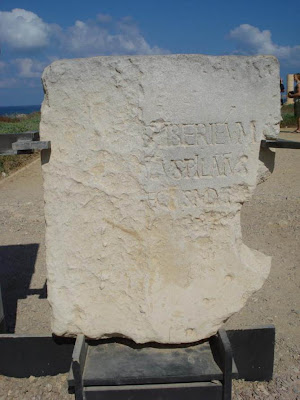
The archaeology of the site has also produced the Pontius Pilate Inscription bearing witness to the historicity of the man condemning Jesus Christ to be crucified.
Replica of the Pilate Inscription
Translation of the Pilate Inscription
Pilate's famous question at Jesus' trial was "What is Truth?" and people are still asking that question today. Many are longing to find what is real, consistent, dependable. I am thankful for the trip to Israel that brought an even great 'real-ness' to the eternal, trustworthy pages of Scripture.
How has God proven Himself and His Word 'real' and 'true' to you recently?
To catch all the Israel 2011 posts be sure to Subscribe or Follow this blog. See boxes to the right.
Remembering Israel Day 2b - Mt. Carmel (coming soon)
WARNING:
Exposure to such material as pictures and testimony of the Promised Land, its geography, character, history, and beauty often creates an insatiable longing to travel and experience these things for one's self.
You have been warned!
If you would be interested in participating in a similar study trip, please contact me.
Here's the web-version of our latest prayer letter. If you are interested in the full story including the "Kids' Korner" update, please send me an email.
Before students and staff of arrived from Jeju, Korea, the Canadians took some time to prepare for their arrival and sneak away to a couple sites.
Undoubtedly the highlight of the day was Tel Gezer across a small valley from the modern kibbutz of Gezer. Gezer was one of Solomon's fortified cities, boasts 26 layers of civilization and one of the oldest Canaanite fortifications.
According to 1 Kings 9:15 Solomon fortified 3 key cities - Gezer in the South, Megiddo protecting important travel and trade routes through the Jezreel Valley, and Hazor in the North. The gates have been unearthed at each of these locations from the same time period and built to strikingly similar specifications.
Gezer
Standing inside Solomon's 6-chamber gate at Gezer
Though we did not visit Megiddo and Hazor Day 1 it is worth showing their relation to Gezer here. Seeing the Bible come to life throughout the whole land of Israel was so exciting. These three ancient cities fortified by Solomon give great support to his historicity and the Bible's accuracy!
The Welcome Center at Megiddo displayed an incredible scale model of the entire archaelogical site. The most fascinating feature of this model were the lifts which would raise certain sections of the model to reveal other levels of civilization.
Scale Model of Solomon's 6-chamber gate at Megiddo.
At Hazor the following sign described practically the exact same gate found at Solomon's other fortified cities.
Sign documenting the discovery of Solomon's 6-chamber gate
Despite denials of the Bible's accuracy, the historicity of biblical characters, and the Jewish claim to the Holy Land, the archeological evidence is mounting and leaving little room for debate. The Bible is true, accurate, and lays claim on our lives to worship the great God who has revealed Himself through the pages of His word and the annals of human history.
To catch all the Israel 2011 posts be sure to Subscribe or Follow this blog. See boxes to the right.
Remembering Israel Day 2 - Jezreel Valley(coming soon)
WARNING:
Exposure to such material as pictures and testimony of the Promised Land, its geography, character, history, and beauty often creates an insatiable longing to travel and experience these things for one's self.
You have been warned!
If you would be interested in participating in a similar study trip, please contact me.
and is expressed through thoughts, emotion, and willful acts and language
affecting every resource at one's disposal.
Let's take a moment to consider just a couple verses of God's Word.
We are commanded to glorify God in all that we do.
"Whether therefore you eat, or drink, or whatsoever you do, do all to the glory of God."
1 Cor. 10:31
We are always serving (worshiping) God or something/someone else.
"Know you not, that to whom you yield yourselves servants to obey, his servants you are to whom you obey; whether of sin unto death, or of obedience unto righteousness?"
Rom. 6:16
Upon reflection of this definition and these verses here are my suggestions for the implications of Real Worship:
Worship is always active.
We constantly choose who or what we worship. We need to think about the object of our worship more often to keep our focus on the One who deserves it. Maybe you've heard it said:
"Just two choices on the shelf, pleasing God or pleasing self."
Worship is always giving or taking.
We show the 'worth' of our object of worship by what we offer or expect. When we are worshiping self, our expectation of others grows to uncontrollable and impossible limits. When we worship God, we offer sacrificially to Him which leads us to our next point.
Worship is always costly - to every asset of life.
We prioritize our time, money and all of our resources to the thing(s) we are worshiping. A good diagnostic tool in determining what we are worshiping is honestly asking ourselves where we spend our time and money.
Worship is always holistic - to every area of life.
All our thoughts, all our words, and all our actions worship. There is nothing that is "un-sacred" when it comes to worship. Ever think we have private things that don't concern God or others? Think again! Every area of life is affected by and actively worships our god/God.
Worship is always happening.
Considering the points above, how could there ever be a time we are not worshiping? With that in mind, we would do well to have the thought ever on our minds, "Who/what am I worshiping?"
Do you have anything to add to this? From your study of Scripture, what does Real Worship look like in our lives?
A day like when you are eating the last few pieces of lemon bread from the container and realize the container is full of earwigs - after you eat a piece! ( That's another story for another post...)
Getting back to the office the other day I was enjoying the remainder of my lunch - a delicious apple.
I looked down at the luscious fruit before me in all its partially eaten glory and witnessed the sight you see below. I laughed out loud and grabbed my tablet for a picture.
Sometimes you just have to laugh at life!
Hasty or Hungry?
I asked a number of WOLBI students for their opinion. Was it hasty or hungry?
How often do we rush into things without "looking before we leap." It is so important to consider the consequences of our actions and not merely be ruled by our appetites.
Apparently everything came out okay, the incident happened last week and there has still been no sign of the missing sticker.
I recently attended a Praise Team orientation at our local church. We sang together, reviewed our corporate 'policy' of blended worship and what that means, and spent some time considering this post's title question.
What is worship? What is real worship?
One of my greatest concerns is the movement calling anything to do with music "worship," taking the offering and then having a 'time of worship', or participating in 'worship' and then listening to a message. I dreadfully fear we are missing the point sometimes. It may seem like a matter of semantics but I try to watch for this in my own life and ministry by referring to the group I work with as a "Praise Team" as opposed to a Worship Team.
Why bother? What's the big deal?
Jon playing the Harp as unto the Lord in the City of David
Well, I think we are missing out when we relegate worship to the sad few minutes of singing we do as a corporate body of believers. If this is all worship is, then the worship we are offering is unworthy of so great a God. Think about it, if this is how we define worship, we are giving God a sparse few minutes out of our week. Worship must be more.
So what is worship?
As we considered this question, here is my suggested definition of worship:
Worship is ascribing worth to something or someone
and is expressed through thoughts, emotion, and willful acts and language
affecting every resource at one's disposal.
One of the things I realized in this exercise was that I need to choose to worship God allthetime! God has wired us and all of creation to worship (Psa. 19) all the time. Not a moment goes by when I am not worshiping something or someone. I need to make sure the focus of my worship remains where it belongs - on our Almighty, Creator-Redeemer God day-by-day and even moment-by-moment.
What are your thoughts about worship?
How would you define worship? Do you have anything to add to the definition above?
Please leave a comment and stay tuned for the next installment as I consider Real Worship exploring the practical, far-reaching implications of worship.
I need to be the first to admit I am not the greatest reader, the fastest reader, or consistently retain all I read. I am however passionate about reading and passing on my love for literature to others.
Of all things, I discovered in a book the following anecdote. A famous magician was once asked, "How do you keep your incredible illusions a secret." "That's easy," came the reply, "I write them in books!"
Don't take the chance of missing out on all life has to offer, Read on Purpose!
Here are some of the things I've learned over the years:
1. Set a goal. Each year I set a goal for the number of books I read to always push myself to read more. Start small. One book per month and choosing smaller-ish books to get started is reasonable for most people I've talked to. As an aside, I also track magazines and booklets that I read and allow every five magazines to equal one book in the count (see #2).
2. Keep track of what you are reading. Since finishing college I have kept track of the books I have read in a notebook. This allows me to not only keep count of how many books I've read for my yearly goals but it also lets me ponder whether I am balanced in my reading ie. too much fiction, etc.
3. Keep a highlighter and writing utensil close. Always mark up books you read (as long as they are yours of course). I know for some of you, this is a major stumbling block but hear me out. As a speaker/teacher I am constantly looking for illustrations, quotes, and solid material to encourage and educate others. Often I remember that there is something great in a particular book but I just can't seem to find it. I don't know about you but I just don't have time to re-read everything everytime I need a piece of data. UNLESS, of course, I marked the book and the content is easy to find. I always keep a mechanical pencil and highlighter handy and am very free to dog-ear pages or sticky note an important page. Let the research and reading you've done last you a life-time by developing your own system of re-tracing that 'nugget' of wisdom. Just give it a try! Close your eyes if you have to the first time you deface the page but release your inhibitions and just go for it!
First off, I love to read! My wife regularly reminds me that I am a geek. In fact my oldest son (who also seems to have a love for books, learning, and just 'knowing stuff') looked at me one day very matter-of-factly declaring, "We are geeks, right Dad?" "Yes, I guess so son," I replied. "But that's OK if we are geeks together, right Dad!?"
Truth be told, I also have a slight addiction to hoarding books. I am working on that but it is not an altogether undesirable problem to have.
Maybe you've heard it said,
"Leaders are Readers,"
or
"If you stop Reading today, you'll stop Teaching tomorrow!"
A simple Google search of the "importance of reading" will produce a plethora of articles suggesting multitudes of blessings for simply cracking a book. Here are a few benefits from one article in that search:
-Development of language skills
-Mental development
-Stimulate eye muscles
-Improve conversation skills
-Improve concentration
-Acquire knowledge
...and the list goes on and on.
I take those to heart and feed the addictive tendencies toward bookworm-ism. Why not pick up an interesting-looking but slightly neglected tome around your house.
On the way from Canada to Israel to meet our Asian friends, the group leaders and I had the privilege of a few hours in London, England. With our spare time we departed Heathrow International Airport on "the Tube" (London's subway is a very economical way to travel) and headed into the city to see the sights of the British Museum.
The British Museum boasts one of the largest collection of Biblical Antiquities in the world and did not disappoint. I wandered and wondered in amazement almost running from room to room snapping as many photos and placards as I could to preserve maximum data for future reflection and classroom enhancement. (Unfortunately all that data is in the hands of the thief who stole my camera at the Heathrow airport - I learned a valuable travel lesson here though: never take untested equipment ie. my new backpack. It unzipped itself rushing through airport. Always use a biner to keep zippers tight.)
I was amazed to see history come to life and stand beside so many things I have taught about in class.
Mark Strout, WOLBI Exec. Dean,
with the Black Obelisk of Shalamaneser III.
A portion depicts Israel's King Jehu offering tribute
to Assyria's Shalamaneser III.
The Cyrus Cylinder declares displaced people
may return to their homes
to rebuild their places of worship.
This allowed Jewish people under Zerubbabel
to return to Jerusalem and begin rebuilding the Temple in 536 BC.
After much treasure seeking and historical discovery, we returned to Heathrow to continue the adventure of a lifetime. Next stop - the Promised Land!
To catch all the Israel 2011 posts be sure to Subscribe or Follow this blog. See boxes to the right.
Remembering Israel Day 2 - Caesarea Maritima (coming soon)
WARNING:
Exposure to such material as pictures and testimony of the Promised Land, its geography, character, history, and beauty often creates an insatiable longing to travel and experience these things for one's self.
You have been warned!
If you would be interested in participating in a similar study trip, please contact me.
It is hard to believe it has already been months since I walked the dusty paths of the Holy Land.
I was blessed to travel with the incredible students and staff of the Jeju Island campus of the Word of Life Bible Institute. The WOLBI Asia campus just opened Fall of 2010 with students from South Korea, Japan, Canada, and the USA.
Everyone always asks, "How was it?" and my response is usually the same...speechlessness. How do you describe something so powerful, life-changing, and beautiful? Seeing the Scriptures I have known and studied for years come to life before me was absolutely indescribable!
So here is a feeble effort to remember, reflect, and share just a glimpse of the wonder that was Israel 2011.
WARNING:
Exposure to such material as pictures and testimony of the Holy Land, its geography, character, history, and beauty often creates an insatiable longing to travel and experience these things for one's self.
You have been warned!
To catch all the Israel 2011 posts be sure to Subscribe or Follow this blog. See boxes to the right.
If Adam and Eve are not historical, there is no original sin. If there is no original sin, what is the point of the Bible (if Genesis is myth what in the Bible isn't myth??), what is the point of a Saviour, what is the point of life, what is the point of anything?
We need to be careful in making concessions to "science falsely so called" when it comes to creation and the text of the book of Genesis.
Do you like free money? Do your friends like free money? Should anyone really have to ask this question? Isn't it obvious?
We all like to have a little extra money in our pockets, and Word of Life Bible Institute understands this! They've made it easy for students and our friends who are interested in the BI to get some extra money!
"But, how?"
Well, with the Alumni Gift Award of course! Each year students are handed these little pink award slips to distribute to people we know. The "Hallelujah Chorus" resounds as we prepare to give them out to all our friends!
Who it's for: anyone interested in applying to the BI in September 2011 or September 2012.
How to get one: any current or graduated student can give this award to a friend who is planning to apply to the BI for 2011 or 2012. A current student can get award slips from the admissions office at WOLBI. Alumni can print this one.
How much it's worth: this award is unique in that both the applicant AND the student giving the award receive money! The person applying will acquire $200 off their tuition (split between the two semesters) and the current or graduated student who gave the gift award will receive a check for $100 in the mail once the applicant enrolls in the September!
How it works: *IMPORTANT* to receive this award, the award slip MUST be sent in WITH the new application.
Instructions for applicants:
Mail Application: send pink award slip in the same envelope with your application. Online Application: if you are applying online, please email the admissions department (admissions@wol.ca, alliep@wol.ca) as soon as you have submitted your application and let them know that you have an Alumni Gift Award. Then, proceed to mail it in so we can process it!
Application Turned in at a Recharge weekend or Campus Days event: simple, just give us the award slip when you give us the application. For those of you who are wondering, YES you do get the $300 for applying at Recharge or Campus Days AND the $200 for Alumni Gift, totaling $500!!!
*The Perks*: This is a great way for a new applicant to get an extra $200 off their tuition. Extra finances are sometimes hard to come by these days, so every little bit counts! ALSO, we students in turn get rewarded for rewarding our friends! Once the applicants enroll for the fall, Word of Life will send $100 in the mail for each gift award we handed out! Why WOULDN'T we take advantage of this opportunity! It's a win-win situation for everyone!
If you'd like to be a part of this offer, or have any questions, please contact our admissions department!
Email: AllieP@wol.ca, admissions@wol.ca, CassandraJ@wol.ca
Phone: 519-376-3516 begin_of_the_skype_highlighting519-376-3516end_of_the_skype_highlighting ex. 213 or 216. Toll Free: 800-461-3503 begin_of_the_skype_highlighting800-461-3503end_of_the_skype_highlighting
I praise God for the popularity of theTopical vs. Expository Preaching post. It is encouraging to see people all over the world concerned with "Rightly Dividing the Word of Truth."
In response, here is a guest post from my friend, colleague, and co-professor of Homiletics (the art of preaching) here at theWord of Life Bible Institute. EnjoyDoug Reideras he breaks down his thoughts on Iain Murray's article.
I have serious problems with Iain Murray’s argument. Take his five disadvantages:
1.“It assumes that all preachers are capable of making effective sermons along these lines.” This one screamed problem! Someone who isn’t capable of doing an expository sermon should probably not be doing a sermon at all! His point here is saying either that some can’t figure out what most texts are saying (hence the need to always do a topical sermon) or that some can’t preach what the text is saying (you can’t figure out how to put the ideas into words that the people can understand).
a.If you really can’t figure out what Scripture is saying, then why should anyone trust your ability to figure out what Scripture is saying about a topic? The reality is that you can’t. If you can’t do biblical theology, they you can’t do systematic theology. Is theology based on our philosophy or on Scripture?
b.If you can’t figure out how to preach what you see Scripture is saying, then why would a topical sermon be any easier? Should we avoid a subject matter just because it’s hard?
c.This does not mean that you have to understand every passage in Scripture or be able to expound on every idea taught—one must start someplace. There are certainly passages I don’t understand well enough to preach and subject matter I’d struggle preaching, but that shows need for improvement, not a reason to ignore those passages or subject matter.
2.Preaching is emphasizing application, as he’s pointing out. I would agree. Preaching does not equal teaching. But, he is implying that topical sermons emphasize application better. That is not true. It can be true, but there is no direct connection. Of course, I’ll be able to preach a topic that is easier to apply…and ignore all those I don’t like to apply.
3.Interesting…so? :) Maybe more churches need to add the lecture part.
4.And topical preaching’s track record is impressive? That’s almost comical. “It [expository preaching] has never proved popular in the long term, and the reason for that, I think, is clear: a sermon needs a text as the basis for a memorable message.” And there’s the problem—topical sermons do not need a text. In fact, they don’t need Scripture at all.
5.And here again he’s right. There really are reasons for topical preaching. A purely evangelistic message will be topical—you’re talking about salvation, which is a topic. But if every sermon from the pulpit is about salvation, then the people starve.
The only way to do a good topical message is to consider all texts that deal with the topic, otherwise one is only considering texts that support one’s own concept of the idea. If topical messages are to be preferred, that implies that considering all texts is somehow easier, which it is not, or that one doesn’t really need to consider the entirety of Scripture on a topic, which produces eisegesis. If I don’t consider the entirety of Scripture, then I’m no longer doing induction (the basis of systematic theology) and it will be very easy to drift into heresy. Topical messages are inherently deductive (start with the idea and then look for backup support).
Again, that does not mean topical messages don’t have their place. There’s a good reason for them and to use them, but someone who only preaches expository messages, at worst, may bore people if he preaches poorly (as the author points out) whereas someone who preaches topical messages, at worst, will go into heresy. For example, say I wanted to preach the idea that God made homosexuals to be homosexuals and intends them to live that way? Could I preach that topic? Sure could…and I’d have a boat load of individual verses to back my topic up. On the other hand, good luck trying to get that idea across using expository preaching without sounding contrived. :)
Raise an ANTHEM of praise through a life of purity. Enjoy as Pastor Piper shares this helpful acrostic on the battle with temptation.
I appreciate John Piper's heart for God, his passion for prolific writing and the sharing of God's truth. I would disagree with his use of Matt. 11:12 as an illustration and likely his theology of the kingdom but am grateful for his heart for God and pastoral ministry. I would also add Romans 6 to "Say No" as we 'reckon ourselves dead to sin!'
May God richly bless as we seek to worship Him in our minds!!
Image via WikipediaI have in mind men and women. For men it's obvious. The need for warfare against the bombardment of visual temptation to fixate on sexual images is urgent. For women it is less obvious, but just as great if we broaden the scope of temptation to food or figure or relational fantasies. When I say "lust" I mean the realm of thought, imagination, and desire that leads to sexual misconduct. So here is one set of strategies in the war against wrong desires. I put it in the form of an acronym, A N T H E M.
A – AVOID as much as is possible and reasonable the sights and situations that arouse unfitting desire. I say "possible and reasonable" because some exposure to temptation is inevitable. And I say "unfitting desire" because not all desires for sex, food, and family are bad. We know when they are unfitting and unhelpful and on their way to becoming enslaving. We know our weaknesses and what triggers them. "Avoiding" is a Biblical strategy. "Flee youthful passions and pursue righteousness" (2 Timothy 2:22). "Make no provision for the flesh, to gratify its desires" (Romans 13:14).
N – Say NO to every lustful thought within five seconds. And say it with the authority of Jesus Christ. "In the name of Jesus, NO!" You don't have much more than five seconds. Give it more unopposed time than that, and it will lodge itself with such force as to be almost immovable. Say it out loud if you dare. Be tough and warlike. As John Owen said, "Be killing sin or it will be killing you." Strike fast and strike hard. "Resist the devil, and he will flee from you" ( James 4:7).
T – TURN the mind forcefully toward Christ as a superior satisfaction. Saying "no" will not suffice. You must move from defense to offense. Fight fire with fire. Attack the promises of sin with the promises of Christ. The Bible calls lusts "deceitful desires" (Ephesians 4:22). They lie. They promise more than they can deliver. The Bible calls them "passions of your former ignorance" (1 Peter 1:14). Only fools yield. "All at once he follows her, as an ox goes to the slaughter" (Proverbs 7:22). Deceit is defeated by truth. Ignorance is defeated by knowledge. It must be glorious truth and beautiful knowledge. This is why I wrote Seeing and Savoring Jesus Christ. We must stock our minds with the superior promises and pleasures of Jesus. Then we must turn to them immediately after saying, "NO!"
H – HOLD the promise and the pleasure of Christ firmly in your mind until it pushes the other images out. "Fix your eyes on Jesus" (Hebrews 3:1). Here is where many fail. They give in too soon. They say, "I tried to push it out, and it didn't work." I ask, "How long did you try?" How hard did you exert your mind? The mind is a muscle. You can flex it with vehemence. Take the kingdom violently (Matthew 11:12). Be brutal. Hold the promise of Christ before your eyes. Hold it. Hold it! Don't let it go! Keep holding it! How long? As long as it takes. Fight! For Christ's sake, fight till you win! If an electric garage door were about to crush your child you would hold it up with all our might and holler for help, and hold it and hold it and hold it and hold it.
E – ENJOY a superior satisfaction. Cultivate the capacities for pleasure in Christ. One reason lust reigns in so many is that Christ has so little appeal. We default to deceit because we have little delight in Christ. Don't say, "That's just not me." What steps have you taken to waken affection for Jesus? Have you fought for joy? Don't be fatalistic. You were created to treasure Christ with all your heart – more than you treasure sex or sugar. If you have little taste for Jesus, competing pleasures will triumph. Plead with God for the satisfaction you don't have: "Satisfy us in the morning with your steadfast love, that we may rejoice and be glad all our days" (Psalm 90:14). Then look, look, look at the most magnificent Person in the universe until you see him the way he is.
M – MOVE into a useful activity away from idleness and other vulnerable behaviors. Lust grows fast in the garden of leisure. Find a good work to do, and do it with all your might. "Do not be slothful in zeal, be fervent in spirit, serve the Lord" (Romans 12:11). "Be steadfast, immovable, always abounding in the work of the Lord" (1 Corinthians 15:58). Abound in work. Get up and do something. Sweep a room. Hammer a nail. Write a letter. Fix a faucet. And do it for Jesus' sake. You were made to manage and create. Christ died to make you "zealous for good deeds" (Titus 2:14). Displace deceitful lusts with a passion for good deeds.
I grew up with what I thought was a drug problem, my parents always drug me to church. Studied at New Brunswick Bible Institute. Married my High School, long-distance sweetheart. Have 3 beautiful kids. Serve at WOLBI as Dean of Men, Dean of Ministry, and Professor of Bible Survey.




 Posts
Posts



